The AI Search Revenue Growth Blueprint™ · Boardroom Edition
Become the business search engines trust, AI recommends, and customers choose.
This is not an SEO audit. It's a growth blueprint that shows you exactly what's stopping your
business from being the obvious answer on Google, in AI search, and at the moment someone is
ready to buy. Then it hands you the system to fix it.
$497 · ten strategic assets · delivered within 5 working days of your
discovery conversation · the fee credits toward your install or retainer.
Run personally by Israel Obiagba, 8+ years a software engineer (mission-critical
systems for the NNPC, the Central Bank of Nigeria, and the Nigerian Army), and creator of the
6-Pillar AI SEO Framework.
Before we talk about SEO · let's talk about revenue
Every month your business pays an invoice it never receives.
It doesn't arrive in your inbox. Your accountant never records it. No bank ever debits your
account. You pay it anyway, and it looks like this:
A customer who found your competitor first.
A journalist who quoted someone else.
An AI assistant that recommended another brand.
A prospect who searched, didn't find enough trust signals, and moved on.
A high-value keyword you should own, but don't.
A page that could have generated revenue but was never built.
Content that exists but can never rank, because it was published without a system.
Not one of those shows up on a profit-and-loss statement. Together they quietly become one of
the biggest expenses in a growing business. And most companies answer it by doing more:
more blog posts, more ads, more backlinks, more tools, more retainers, more meetings. Plenty of
activity. Very little leverage. Because activity doesn't fix a structural problem. Structure does.
The mechanism
Why most SEO fails before it ever has a chance to work.
SEO isn't dead. Content marketing isn't dead. What's disappeared is the luxury of doing these
things independently.
For years businesses were told SEO was a checklist. Publish more posts, fix a few technical
issues, buy some backlinks, target more keywords, wait, repeat. Sometimes it worked. Today it
rarely does, and not because those activities stopped mattering. They were never designed to
work on their own. Google stopped judging pages in isolation. AI systems stopped rewarding
answers in isolation. Modern search judges systems, and it asks questions like:
Does this business demonstrate expertise consistently?
Is the content connected by clear topical authority?
Can this business be trusted enough to quote?
Does every important page reinforce every other important page?
Is the business understandable to both humans and machines?
The problem isn't visibility. It's structural authority. Think of your website
like a city. A few beautiful buildings don't make a city work. You need roads, power, water,
transport. Publishing another article onto a badly structured site is like putting up another
skyscraper in the middle of a desert. It might look impressive. It won't create an economy.
Real data · not opinion
Strategy is only as good as the evidence underneath it.
Every recommendation in your Blueprint sits on live search data pulled for your exact services
and market. Same Google keyword and SERP databases advertisers use to set million-dollar
budgets. One Toronto legal term costs
$57.28 per ad click. Your
Blueprint shows which terms like that you're invisible for, what each one is worth to you in
dollars, and where it sits in the order of what to fix first.
The system behind every recommendation you'll receive.
After analysing businesses across a lot of different industries, one pattern kept showing up.
Every high-performing website was quietly solving the same six structural problems. Different
order, different tactics, same underlying principles. So every recommendation in your Blueprint
traces back to one of these six pillars. Nothing gets included because "it's good practice."
Pillar One
Demand Discovery & Opportunity Mapping
Before we fix anything, we find where your real opportunities sit. Not every keyword deserves your attention. Not every competitor is worth chasing. We isolate the highest-value openings first, so your time and your budget buy business outcomes instead of more traffic.
Pillar Two
AI Search Visibility
More and more, customers get their answer before they ever click a website. This pillar gets your business into the small set of sources AI systems trust enough to quote, summarise and recommend. Because if AI never finds your expertise, your customers may never find you.
Pillar Three
Content That Builds Commercial Authority
Search volume is a bad reason to publish anything. Every article, page and guide should be strengthening your authority around the problems customers actually pay you to solve. This pillar turns scattered content into one connected system that compounds.
Pillar Four
Trust & Market Presence
Visibility without trust rarely converts. This pillar strengthens the signals that tell search engines, and buyers, that your business is credible and established. However someone finds you, whether that's Google, AI, Maps or a referral from a friend, the experience should reinforce the same thing.
Pillar Five
Authority Expansion
Trust grows when other trusted sources recognise you. This pillar covers the external signals that make your business harder for competitors to ignore and easier for search systems to recommend. Authority is earned. But it can also be engineered.
Pillar Six
Sustainable Growth Systems
Most businesses plateau because every improvement depends on someone finding the time. This pillar builds repeatable systems, so your visibility, content and authority keep growing without reinventing the process every month. The goal was never just to rank. It's to own a search asset that's worth more each quarter.
Most consultants hand you recommendations. This framework hands you the order.
Knowing what to do is only half the job. Knowing what comes first, what can wait, what
gives you the most leverage, and how each decision sets up the next one is what turns a strategy
into growth. These six pillars are the strategy layer. The execution disciplines underneath them
are written up in full in my 6-Pillar AI SEO Framework.
What you're actually investing in
You're not purchasing a report. You're receiving ten strategic assets.
When this is done you don't get handed a document and wished luck. You get a set of assets
built to help your business make sharper decisions, back the right opportunities, and execute
without second-guessing every step. Every recommendation written down. Every opportunity ranked.
Nothing in there without a job to do.
01
The Blueprint
Your executive growth strategy
The heart of the engagement. Where you stand now, why you aren't growing faster, what's quietly costing you visibility, what to fix first, and what can safely wait.
02
Opportunity Intelligence Report
Where growth is already waiting
High-value searches, underserved demand, content gaps, and the places your competitors are genuinely exposed. So you compete where winning is actually achievable, instead of everywhere at once.
03
AI Search Visibility Assessment
Can AI platforms recommend you?
Whether your business is built to be discovered, understood, trusted and quoted by modern AI systems. Visibility tomorrow will depend on much more than rankings today.
04
Technical Foundation Review
Remove the invisible barriers
The structural problems quietly limiting every marketing effort you make: discoverability, experience, trust signals, and whether search engines can understand your site at all. The goal isn't technical perfection. It's a foundation strong enough to carry everything after it.
05
Content Authority Architecture
Expertise that compounds
The topics, themes and customer questions your business should own. So "what should we publish next?" stops being a monthly debate.
06
Competitive Intelligence Brief
Learn from rivals without copying them
Where competitors are winning, where they're exposed, and which of their strengths you can safely ignore. The point isn't imitation. It's advantage.
07
Revenue Growth Roadmap
Know exactly what happens next
Every recommendation put in order: what to do first, what to delegate, what to postpone, what produces quick wins, and what builds the momentum you'll feel next year.
08
Executive Dashboard
Your whole strategy at a glance
The metrics, priorities and milestones that actually matter, in one view. You'll always know where progress is happening and where attention is needed.
09
Implementation Playbook
Turn strategy into action
Every major initiative broken into steps your team can actually follow. Consulting engagements fail on execution far more often than they fail on advice.
10
Executive Summary
The document you'll return to
The findings, priorities and risks that matter most, distilled for board conversations and budget decisions. When someone asks what your search strategy is, you'll answer in minutes instead of hours.
Together they make up your AI Search Revenue Growth Blueprint™: a working
operating system for visibility, authority and revenue that keeps compounding. Not because more
documents are worth more money. Because better decisions build better businesses.
What this engagement replaces
To build this capability in-house, you'd need to hire eight people.
Not the rankings. Not the traffic. The capability: becoming, and staying, the business
search engines trust, AI platforms recommend, and customers choose. No single specialist holds
every piece of that. So you'd hire several, each one solving a slice of a much bigger problem.
Hire it piece by piece
A search strategy consultant to translate business goals into search goals
A technical SEO specialist to find what's blocking crawling and trust
A keyword & opportunity researcher to surface real commercial demand
A content strategist to decide what gets published, when, and why
An AI search consultant, because ranking and being cited are different problems
A competitive intelligence analyst to find where rivals are actually vulnerable
A data & performance analyst to build the dashboards and read them
A project planner to sequence it all so your team isn't overwhelmed
One integrated engagement
One engagement, one methodology, one coherent set of recommendations
Every deliverable connects to the next instead of contradicting it
Findings arrive already prioritised by business impact, not by discipline
No reconciling eight opinions, eight formats and eight sets of priorities
Built on live market data pulled for your exact services and market
Strategy and sequence in the same document, so nothing stalls at handover
One point of accountability: the person who does the work presents it
A single $497 investment instead of eight separate ones
Every one of those specialists brings real expertise. But hiring them separately buys you a
second problem: different perspectives, different priorities, different methods, different
reports, different recommendations. You wanted clarity and you inherited complexity.
You're not buying more information. You're buying better decisions.
The transformation
Imagine sitting down with your leadership team six months from now.
Instead of saying "I think we should invest more in SEO," you'll be able to say:
"Here's exactly where we're losing visibility. Here's why it's happening. Here's what
matters most. Here's what we can safely ignore. Here's the expected business impact. And
here's the roadmap."
Completely different conversation. Run on evidence instead of a hunch.
Instead of guessing, you'll know. Which opportunities deserve attention, which activities move the needle, which metrics matter, and which investments pay back.
Instead of chasing competitors, you'll build something they can't easily copy. A competitor publishes, you publish. A competitor launches a page, you rush out something similar. Reactive businesses stay one step behind forever. You'll be making decisions from opportunity, not anxiety.
Instead of scattered marketing, one direction. Marketing, sales, content, product and leadership all working off the same picture of what winning looks like.
Instead of hoping AI understands your business, you'll have prepared for it on purpose. You'll know how modern search systems read you today, and what has to change.
Instead of asking "what's next?", you'll already have the answer. New opportunity lands on your desk, or someone questions the budget: you'll know in a minute whether it fits the strategy.
The real deliverable was never a document. It's the confidence to stop chasing every new tactic,
to put money behind the right opportunities, and to look your team, your partners or your
investors in the eye and say "we know exactly where we're going, and why."
Who this is for · and who it isn't
Not every business needs this. That's intentional.
This is for you if…
You treat visibility as a business asset, not a marketing metric.
You already run a good business. It's the visibility that doesn't match the quality of what you actually do.
You're tired of random marketing advice and want principles you can make decisions with.
You're willing to think in years. Authority and trust both compound.
You want to understand why a task matters before your team spends a month on it.
It's not for you if…
You want instant rankings or a guaranteed first-page position. Search authority is built, not manufactured.
You're shopping on price rather than on what the decision is worth to you.
Nobody on your side intends to act on it. A blueprint only creates value when it gets used.
You want a generic monthly SEO package. Different conversation: see the retainer.
You want someone else to own growth outright. I give you clarity and direction. The decisions stay yours.
It lands hardest with professional service firms, healthcare organisations,
education and training providers, SaaS and technology companies, e-commerce businesses chasing
more than transactional traffic, B2B companies with long trust-based buying cycles, and local
businesses that want to own their city. Also founders who are quietly tired of their website
being an online brochure instead of a business asset.
Real people · real reactions
What people say after the work lands.
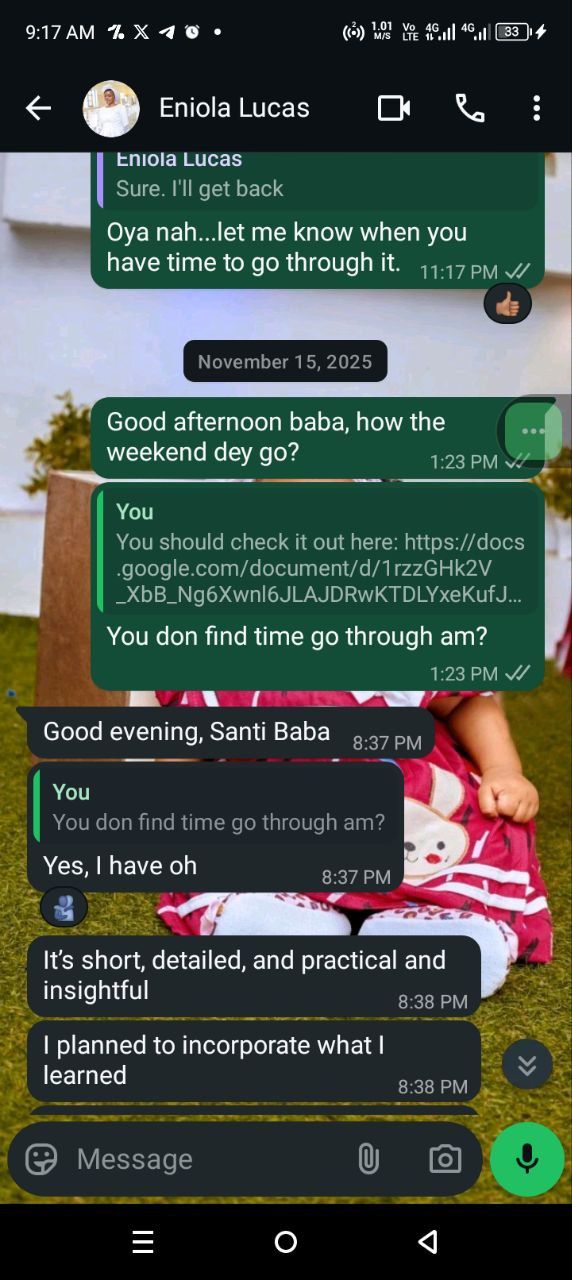
“It's short, detailed, and practical and insightful. I planned to incorporate what I learned.”
Eniola Lucas, Founder
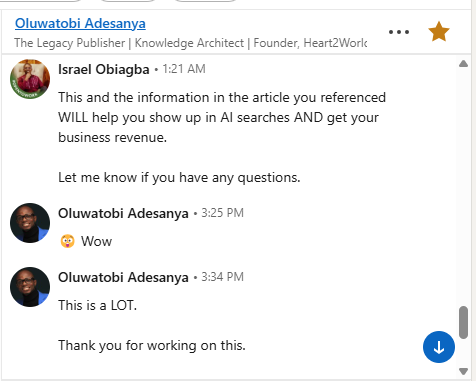
“This is a LOT. Thank you for working on this.”
Oluwatobi Adesanya, Founder, Heart2Work
“I'm just done going through it. It was well detailed.”
Every strategic decision has two costs. Most businesses only measure one.
Looking at any investment, most people ask "what will this cost us?" Good question.
It's also only half of one. The half nobody puts on the board:
what does it cost to do nothing? Delaying a decision doesn't pause the market.
The market just keeps moving without you in it.
While you're deciding, your competitors are publishing, strengthening their authority, fixing
their websites, answering the questions your buyers are asking, earning backlinks, and getting
easier for both search engines and AI platforms to recommend. None of it looks dramatic on any
given Tuesday. Put together, it becomes momentum. And momentum compounds.
Visibility is one of the very few business assets that appreciates. Office
equipment ages. Software goes out of date. Advertising stops working the second you stop
paying for it. Search authority behaves differently: every good improvement strengthens the
next one, and every month of consistent execution makes the following month cheaper. That's
why the businesses that started earlier keep the advantage for years. Not because they worked
harder. Because they started sooner.
None of which means you should rush. Read this, take it to your team, challenge the
assumptions, ask the hard questions. Good investments are rarely made on impulse. Just don't
let it sit for a year because no decision always feels easier than a decision.
What happens next
Five steps. Deliberately straightforward.
Not because the work is simple. Because the complexity shouldn't land on your desk.
1
Discovery. We start with your business. Your objectives, your market, your customers, where you currently stand online, and the outcomes your leadership team actually cares about. I want to understand it before I recommend anything.
2
Strategic research & analysis. A deep evaluation across all six pillars of the AI Search Revenue Framework™: what's already strong, what opportunities are hiding, and what will create the most business impact. No generic templates.
3
Blueprint development. The research turns into a roadmap that hangs together: where you are, where the opportunities sit, and how to get from one to the other. Every recommendation ranked, every phase built on the one before it. In your hands within 5 working days of your discovery conversation.
4
Executive presentation. We go through the strategy together. Not a handover. A working session, where you ask questions, push back on the assumptions and look at alternatives, so you walk away confident in the recommendations and the thinking behind them.
5
Confident execution. The Blueprint is yours now. Run it in-house, run it alongside your current agency, bring in specialists, install the system in your team, or hand it to me to run. My job is to leave you with clarity, not a dependency.
The investment
Priced on the quality of the decisions it enables. Not on page count.
This isn't priced by hours worked or pages delivered. By the time your Blueprint lands, you'll
know where your biggest opportunities are, what's holding your visibility back, which
priorities can't wait, where the money returns most, how to get ready for AI-powered search,
and the order to do all of it in.
One Blueprint your business will keep going back to for months, often years. And if you take
it further, the fee credits toward your install or
retainer, so the strategy ends up paying for part of the
execution.
Who runs your engagement
An engineer's rigour, pointed at your revenue.
I'm Israel Obiagba. For 8+ years I built mission-critical software for institutions including
the NNPC, the Central Bank of Nigeria, and the Nigerian Army. Work where a wrong number isn't
an option. I won Hack Jos 2016, then ran growth as fractional CMO for a Canadian B2B SaaS. Your
Blueprint isn't handed to a junior; I run every engagement personally.
One promise I make every client. I won't recommend something because it's fashionable this
quarter. I won't bury you in complexity to look clever. And I won't confuse activity with
progress. Every recommendation is there to make your business easier to discover, easier to
trust, and easier to choose. Nothing more than that.
The questions every thoughtful decision-maker asks
No. An audit tells you what's wrong: technical issues, a hundred recommendations, information that never gets implemented. This hands you a way to make decisions instead. What's limiting growth, why it's happening, what deserves attention now, what can safely wait, and how each recommendation feeds the next. You're not buying findings. You're buying clarity.
They can, and honestly you should use them. But a tool tells you a page is missing a meta description. It can't tell you which of your services is worth building a whole content system around, where your competitors are structurally weak, or which three moves out of forty will actually change your revenue this year. Tools give you findings. This gives you a sequence of decisions, grounded in live commercial data for your exact market, with the reasoning attached so you can argue with it.
Usually, yes. Strategy and execution are different jobs. Your agency might be excellent at shipping content and fixing technical debt, and still be working without clear direction. Think of the Blueprint as the architectural plan. Your team can build from it, your agency can build from it, or a partner you haven't hired yet can. Either way the strategy stays yours, and it stays independent.
Good. This doesn't replace a strong team, it points one. Most internal teams burn an enormous amount of time deciding what to do next, then second-guessing it. The Blueprint takes that argument off the table so they can spend the month executing instead of debating. Not more work. Just far less wasted work.
Fair question. The point of a first engagement isn't to charge as much as possible, it's to be worth far more than it costs. Every growing business deserves serious strategic thinking before it commits to a large implementation budget, not after. So rather than asking you to sign off on something expensive while you're still guessing, I sell you the clarity first. And if you go further, the fee credits toward your install or retainer.
Surprisingly little. Nearly all of the work sits on my side. What I need from you is the discovery conversation and access to enough information to understand the business, what you're aiming at, and where you currently stand online. Research, analysis and prioritisation are mine to run from there.
Entirely your call. Some businesses run everything internally. Some hand it to their marketing team, some bring in specialists for one or two initiatives, and some bring me back to implement. Nothing about it locks you in. It just means the next decision you make is an informed one.
Yes. The principles behind it are built to outlast algorithm updates. Platforms will change and AI will keep improving, but businesses that consistently show expertise, earn trust, organise their knowledge and treat visitors well keep winning on every platform we've seen so far. Tactics age fast. The foundations barely move.
Because a report informs you and a blueprint directs you. Every page answers a practical question, every priority has a reason behind it, and every action has a place in the order. You also don't just receive it and get left alone with it. We walk through the whole thing together in an executive presentation, where you can challenge the assumptions and pull the reasoning apart before you act on any of it.
Israel Obiagba is a software engineer of 8+ years (he built mission-critical systems for institutions including the NNPC, the Central Bank of Nigeria, and the Nigerian Army) turned revenue-first SEO strategist, and creator of the 6-Pillar AI SEO Framework. You work directly with him. Every engagement is run personally, never handed to a junior.
Request your AI Search Revenue Growth Blueprint™
"Should we invest in this?" is the wrong question. The better one:
what does it cost us to keep making search decisions without it?
Let's start by understanding your business, before I recommend a single thing.
$497 · ten strategic assets · delivered within 5 working days of
your discovery conversation · the fee credits toward your install or retainer.
🚨 Reality Check
Tired of “Plenty Views, Plenty Likes, But Zero Sales”?
You are not lazy. You are just blind.
Right now, running social media ads feels like pouring water into a basket. But your ideal customers are out there. They are typing their exact problems into Google and ChatGPT right now.
Give me 15 minutes live on screen, and I will reveal the exact words your buyers use before they buy.
⚡ We close the doors for the year on November 8th. Do not stay blind.